
Minimalism and maximalism in biotechnology
Biology doesn’t have to sacrifice beauty for scale, neither should biotechnology.

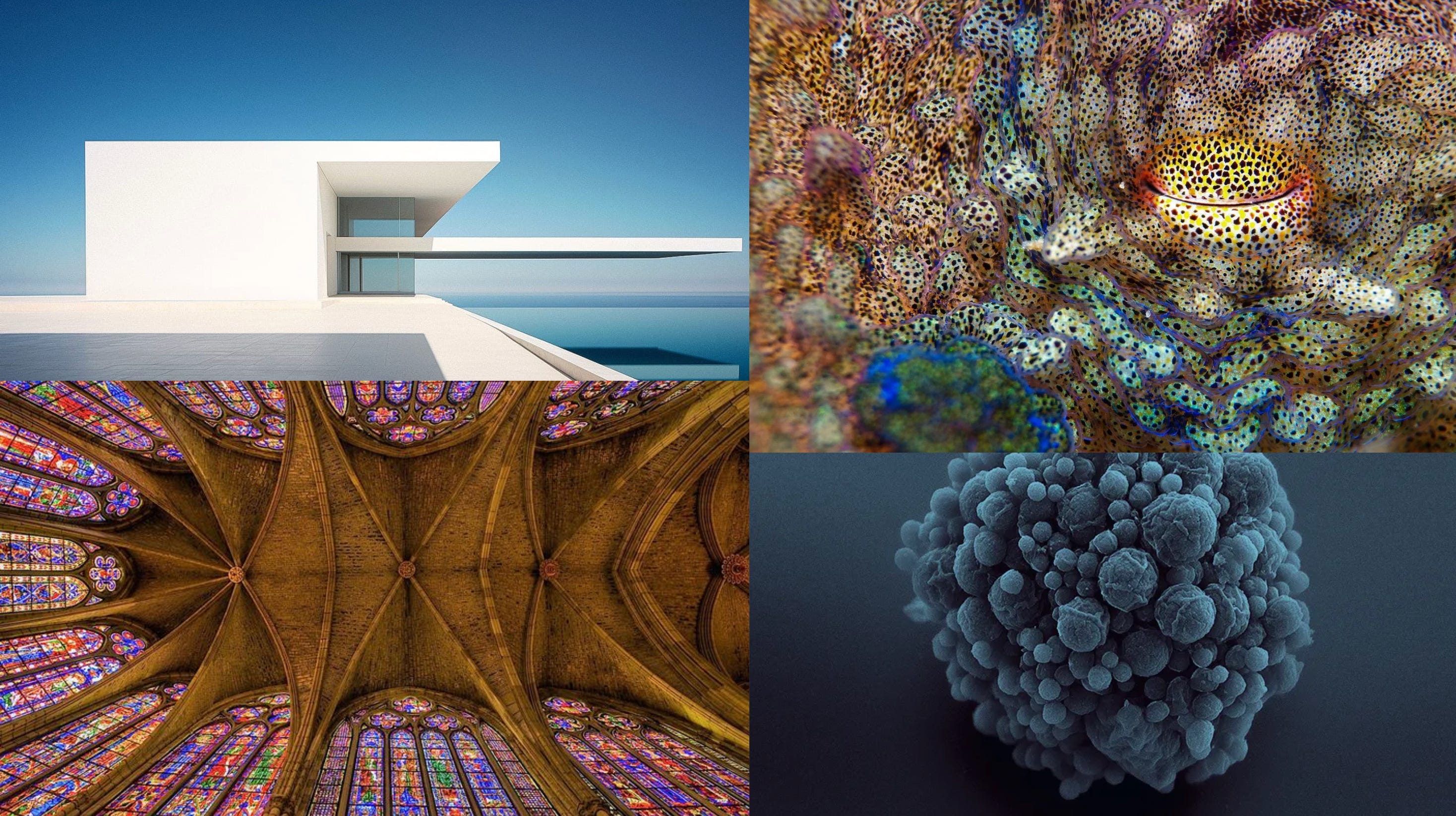
In the last couple of years I’ve seen a lot of criticism1 toward minimalism. People will compare a modern building to a Gothic cathedral and go “when did we stop building beautiful things? Modern design prioritizes convenience, and it is making us sick with its neutral colors, smooth surfaces, narrow constraints, and lack of stories”.
When looking at bioreactors, minimal cells, recombinant proteins, and IVF robots, I cannot help but wonder whether biotechnology is following a similar minimalist ideology by stripping the complexity from wild-type biology.
Broadly speaking, definitions in art and design will say that minimalism is the emphasis on the essence of something and that it avoids expressing the opinion of its creator or any other non-essential wrapping, because “less is more”. Conversely, maximalism could be thought of as the excess and abundance of something, because “more is more”.
But according to whom or to what standards are we making these claims? Is biology minimalist because evolution selects for the survival and reproduction of functional elements by spelling only four letters differently? Or is it maximalist because of the “immense” diversity and symbiotic relationships that emerge from this code, spanning the cell to a world?
After WWII, minimalism arose both due to the need to rebuild cities fast, and as a philosophical statement against the historical maximalism practiced by the elites. Ironically, in simplifying objects, minimalism incentivizes their mass usage and consumption. This is better exemplified by minimalist yet addictive social media interfaces, and is also present in home decoration with programmed obsolescence that results in consumerism and houses that can be built in days and scaled to neighborhoods that look the same.


Minimalism and maximalism, however, are not opposite but intertwining and, in fact, complementary ideologies. A synthetic cell grown in a bioreactor for a single function can seem as minimalist as an iPhone made out of stainless steel and glass running 0s and 1s. But both hold immense power to scale in complexity and thus generate a maximalist amount of AI slop or a biological catalog the size of planet Earth.
Instead of absolute maximalism or minimalism, biology pursues homeostasis. Simple at the impermanent individual level, complex at the enduring population level. Neither waste nor excessive consumption can be afforded. Convenience is required, but details are essential. Biology doesn’t have to sacrifice beauty for scale.
Minimalism critics frequently interpret simplicity as a lack of care, as though the person behind the object is no longer telling a story, and the object is not changing in response to its user. That is actually correct since minimalism prefers silence to opinionated layers. Nonetheless, I would argue that there is no such thing as an absolutely objective piece of art, design, or engineering. The mere fact that minimalism exists means that there are people with the intention of simplifying things. Hence, minimalism does not exhibit a lack of care but a care for different things.
It is also true that in this kind of care, minimalists disregard the function that most of those details could serve. In art, details may communicate a political message. In interior design, texture and color can satisfy the biological need for sensory stimulation. In biology, the layer of feelings, generated by hormones and neurons, is essential to survival and reproduction.
In order to comply with its evolutionary objective function, basically scale up, biology must be convenient. The human brain, for instance, must filter out the majority of input it receives if it wants to distinguish relevant information. No company will make truly custom computers or software but instead standardize in order for millions of people to use them and be profitable.
All technology, including biological engineering, is meant to make life more convenient. Now that ‘convenience’ is defined by bioengineers, minimalist biotechnology prioritizes yields, profits, and scale more than diversity or symbiosis. We can grow insulin in a vat instead of raising zillions of pigs, lose weight without much willpower, grow things near the place where they’ll be consumed instead of relying on long supply chains, eat seedless watermelon, change the bases in an mRNA strand instead of designing a new drug candidate from scratch.
We must consider, though, that reduced effort is a result of reduced choice. Agency flows from carbon to silicon algorithms, your home looks exactly the same as millions of others, twenty t-shirts in your closet are solid gray. You don’t have to worry about digital or physical clutter because the cloud takes care of it, because you don’t own them anymore. Bryan Johnson embraced minimalism for his diet too — “every calorie has to fight for its life”, dismissing flavor for a carefully measured portion of broccoli and lentils.


On the other side of the spectrum, maximalism is often resented for its opulent origins in highly polarized societies. However, during the pandemic, the pendulum swung such that the masses (especially GenZ) adopted this style for their bedrooms, online content, and lifestyle.
With the ever-increasing amount of social media content, individuality and authenticity became a requisite to grow your mind-share. Without much sensory stimulation from the physical world now, our brains actually demanded our rooms to be more dense. Maximalism, then, became a movement that defied convention and believed that expression is not at odds with function. As architect Robert Venturi would say, “less is boring”.
To a world that seems to be changing faster than many of us are comfortable absorbing, we respond with nostalgia. We wear wired earphones, buy vinyls, use analogue cameras, read obscure texts in a version of English that seems almost foreign, and we crave the texture of a paper notebook instead of a blank Notion page when it comes to journaling.
But no matter how seducing, nostalgia can only offer yesterday’s solutions to today’s needs. Many people wouldn’t trade a functional sewage system for a maximalist Victorian bathroom, a classic Jaguar for their autonomous Tesla, expensive gold decorations for Temu-cheap ones, or an AI-generated poster for an oil painting
Today’s maximalism is performative23. The stories are not formed in relation to how we use our objects — like worn leather or a bronze handle smoothed by use — but on how other people see us ‘use’ them when we post about them on Instagram stories. Convenience still wins over craft.
In this regard, biotechnology gave us the “lab-grown” phenomenon that simplifies biology before complicating it more. Cell-based meat, IVF, lab-grown leather and the like are meant to replicate what nature had already created, only through different (supposedly more convenient) means of production.


If we go back 200 years, we will find that authentic maximalism demanded and allowed for maintenance even after the creator was gone. Instead of programmed obsolescence, scale, or disposal, maximalist objects endured to create a relationship with their users. Wool coats got re-lined, cast-iron pans improved with use, and Japanese kintsugi treated fractures as part of the object’s history.
Life requires such maintenance, and our relationships with other living things prove it. In contrast to the sterile environment of a bioreactor where only one species is meant to grow at a time, wild life thrives in an environment of competition and collaboration. Even the most surprising partnerships, between a microbe and a plant, can make the difference in nitrogen fixation.
The few examples of maximalist bioart include Nick Desnoyer’s gene edited A. Thaliana flowers, Christina Agapakis’ cheese made out of bacteria in human microbiomes, Neri Oxman’s Biomorphic ‘spacesuits’, Saša Spačal’s human-mycelium capsule, Norfolk’s purple tomato, gene edited mice that can articulate more complex language, or Biopunk’s very own calls for four-leaf iridescent clovers and translucent frogs.
In terms of products, Loopt’s mushroom coffins join you through your decomposition journey, Stanford researchers engineered skin bacteria to help your immune system fight cancer (which could be made into a creme), Polybion has made leather dyed by bacteria as it grows, and SEED has engineered 2-in-1 cobiotics.
Notably, most of the former examples use bacteria or fungi, which are genetically simpler and thus easier to create new things with compared to humans. Only in the next 15 years will we see the rise of human genetic engineering as a rather artistic and possibly maximalist form of expression. Peptides are already leading the way with enhancement. We might see the day when mRNA program or a gene therapy become more like fahsion we choose rather than immovable parts of us.
If we can learn anything from biology is adaptation. Today’s biotechnology might be minimalist in contrast to yesterday’s biology. It will restrain some choices, but it is very important that we remember to use this in our favor to eventually expand biological diversity and spread new life throughout the universe.
While the word has been popularized to describe a collection of attitudes in men, it can also describe the act of pretending to be something else, only on the surface.
Jean Baudrillard would associate this with the idea of living in a simulation, but that is a story for another day.